The Open Mic Rule: How to Stop Writing 12,000 Lines of Code for 0 Users
The brutal reality-check rule for solo developers terrified of shipping
The 1 AM Bezier Trap
Most solo devs don't fail because we can't write code. We fail because writing code is the most comfortable way to hide from real users.
Six weeks ago around 1 AM, I fell straight into that exact trap.
Recolit is a reading app I built for language learners. You read an article, tap unfamiliar words, and collect the whole batch in one go without breaking your flow.
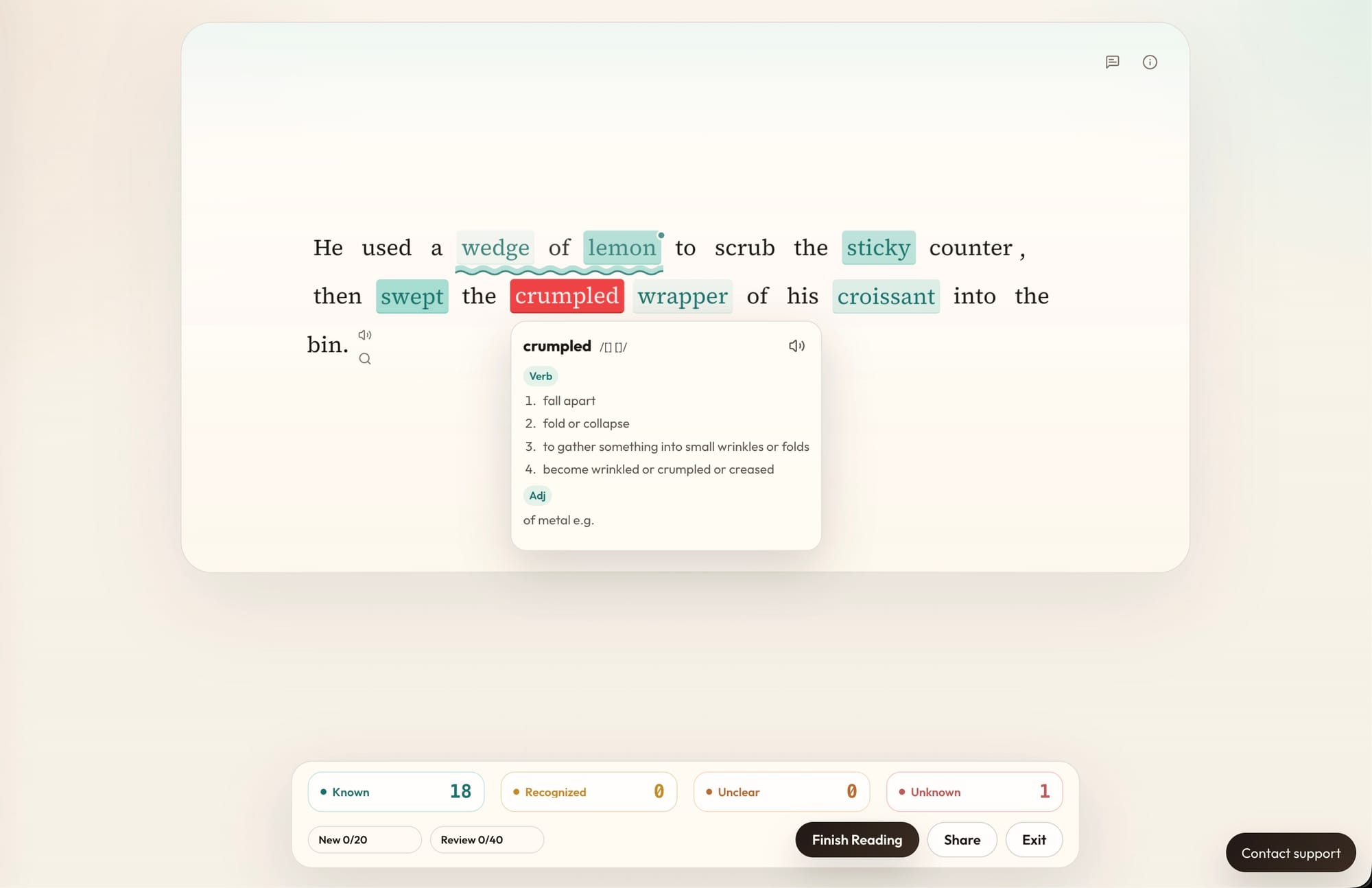
That night, everything was done and ready to ship. The reader worked, and hitting the "Finish Reading" button at the bottom right simply wrote the batch to SQLite.
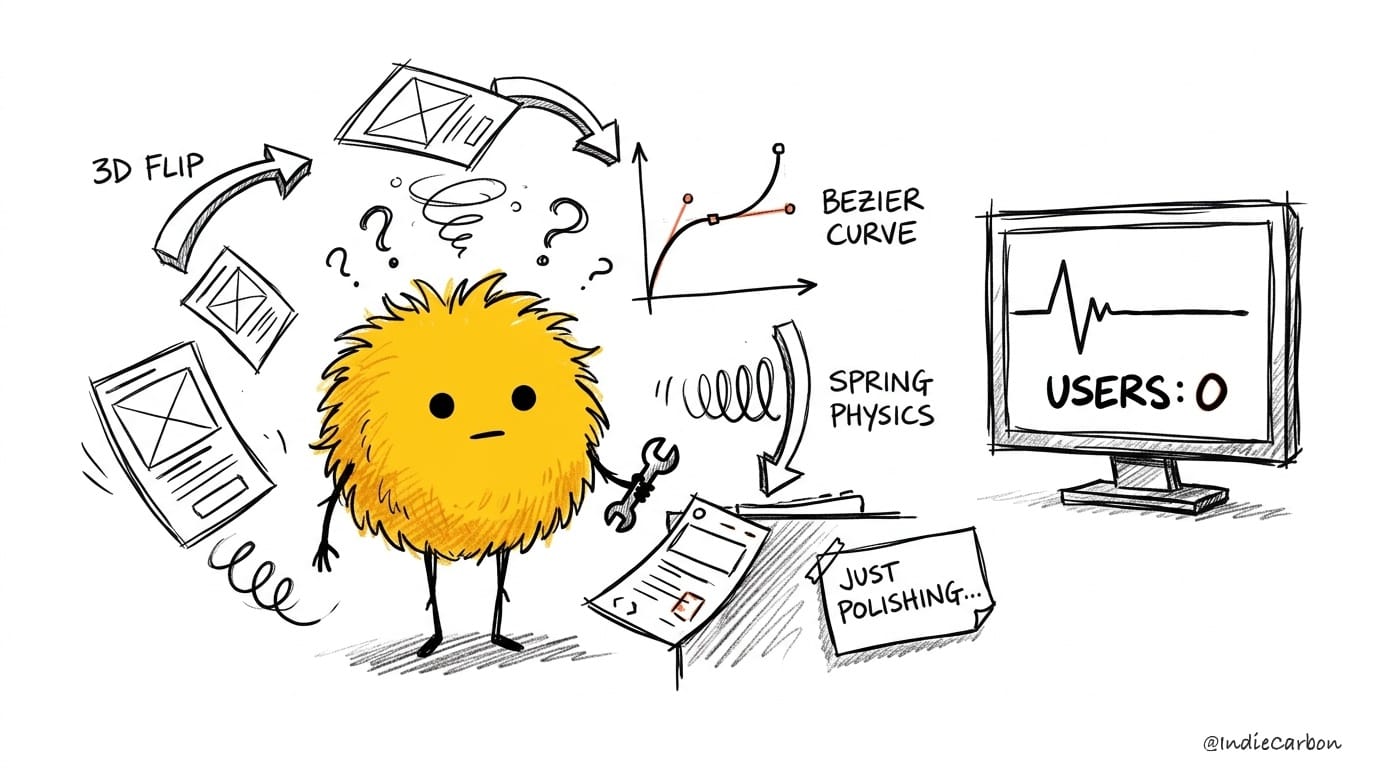
But in my head, a silent database write wasn't enough. I spent three hours in DevTools tuning a cubic-bezier transition—obsessing over how the cards should lift off the page, fan out, and slide into their FSRS decks.
I kept telling myself, "Just a little more polish before I ship."
A complete lie.
Did I ship after wasting three hours on that animation?
Of course not.
I tumbled straight into the next visual rabbit hole—burning the next two days engineering a 3D card-flip animation every time you click to toggle a card's learning status.
Fast forward six weeks. As of today, the dashboard still sits at flat zero.
Localhost is safe. The compiler doesn't judge you. You tweak a CSS property, refresh the browser, and something moves. Tests pass. The terminal stays clean.
Shipping is different. You push to production, refresh the analytics dashboard, and nothing moves. Zero signups. Total silence. That part is terrifying.
Most endless polishing is just cowardice disguised as craftsmanship.
The Cemetery of Private Repos
Look through your GitHub account. Behind the pinned repositories everyone can see, there is an invisible graveyard of private repos.
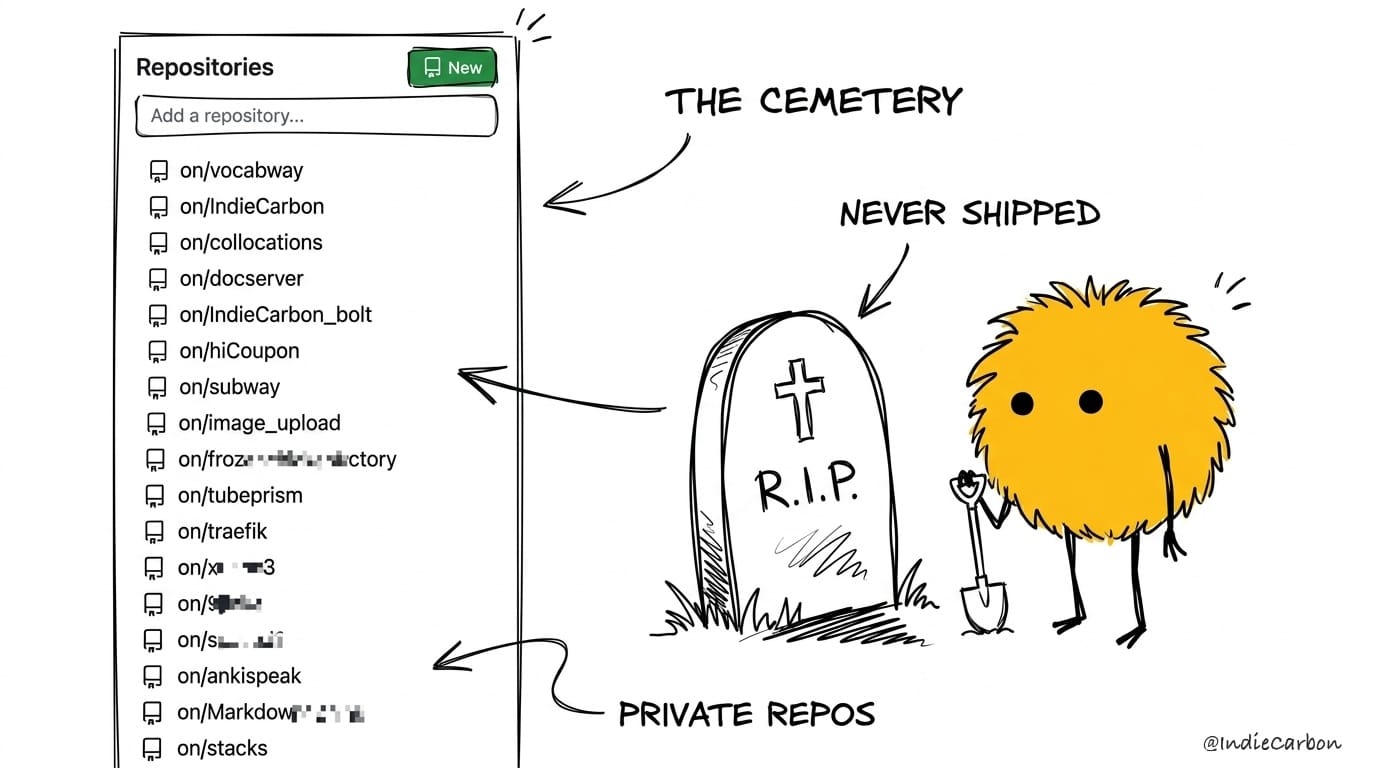
In 2024, I spent four straight months writing twelve thousand lines of code for an automated bookmarking tool. I wrote clean custom hooks, designed database schemas, and even set up Redis queue retries for edge cases that never existed.
I finally shipped it on a quiet Tuesday. Not a single soul signed up. The only visits in my server access logs came from Russian scraping bots 🤦♂️.
The domain name still hits my credit card for $14 every August. A yearly invoice from my own cowardice.
That bookmark tool was just the start. Like almost every indie hacker before me, I blindly built the classic starter pack: a todo list, a bookmark manager, and a markdown note-taking app. Three dead projects nobody ever asked for.
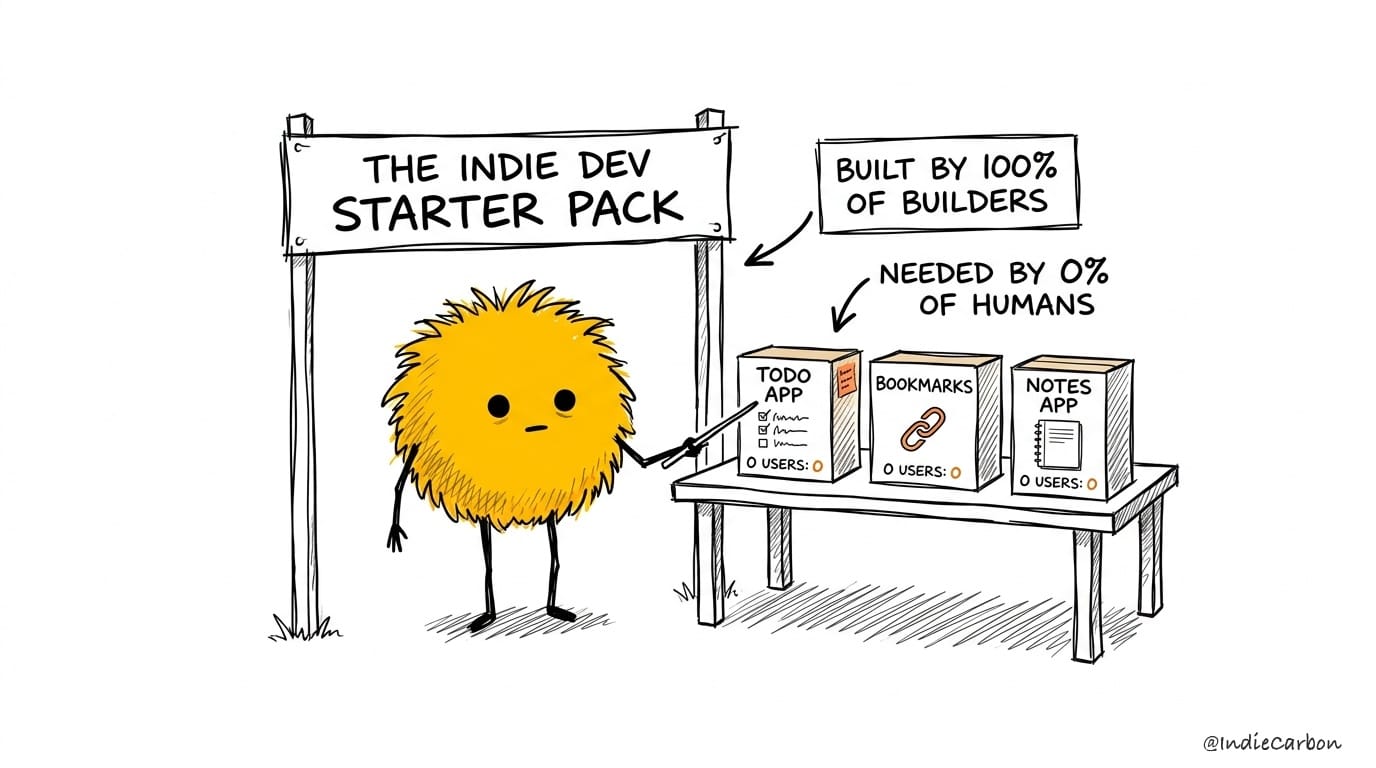
Why do smart builders burn hundreds of hours (and even tokens 😂) writing code for an indifferent void, yet refuse to spend ten minutes talking to a living human being?
Paleolithic Emotions, Godlike Technology
For months, I blamed myself. Laptop shut at 2 AM, staring at another private repo left to rot.
I didn't think about biology. I just assumed I was weak.
That lasted until I hit a line from biologist E. O. Wilson:
"The real problem of humanity is the following: we have Paleolithic emotions, medieval institutions, and godlike technology."
That was the moment I stopped blaming weak willpower or procrastination. I wasn't lazy—at least I looked plenty industrious while tweaking that animation 😂.
The real question was: why was I obsessing over certain tasks while avoiding others like the plague?
Why do we lose whole days in the code?
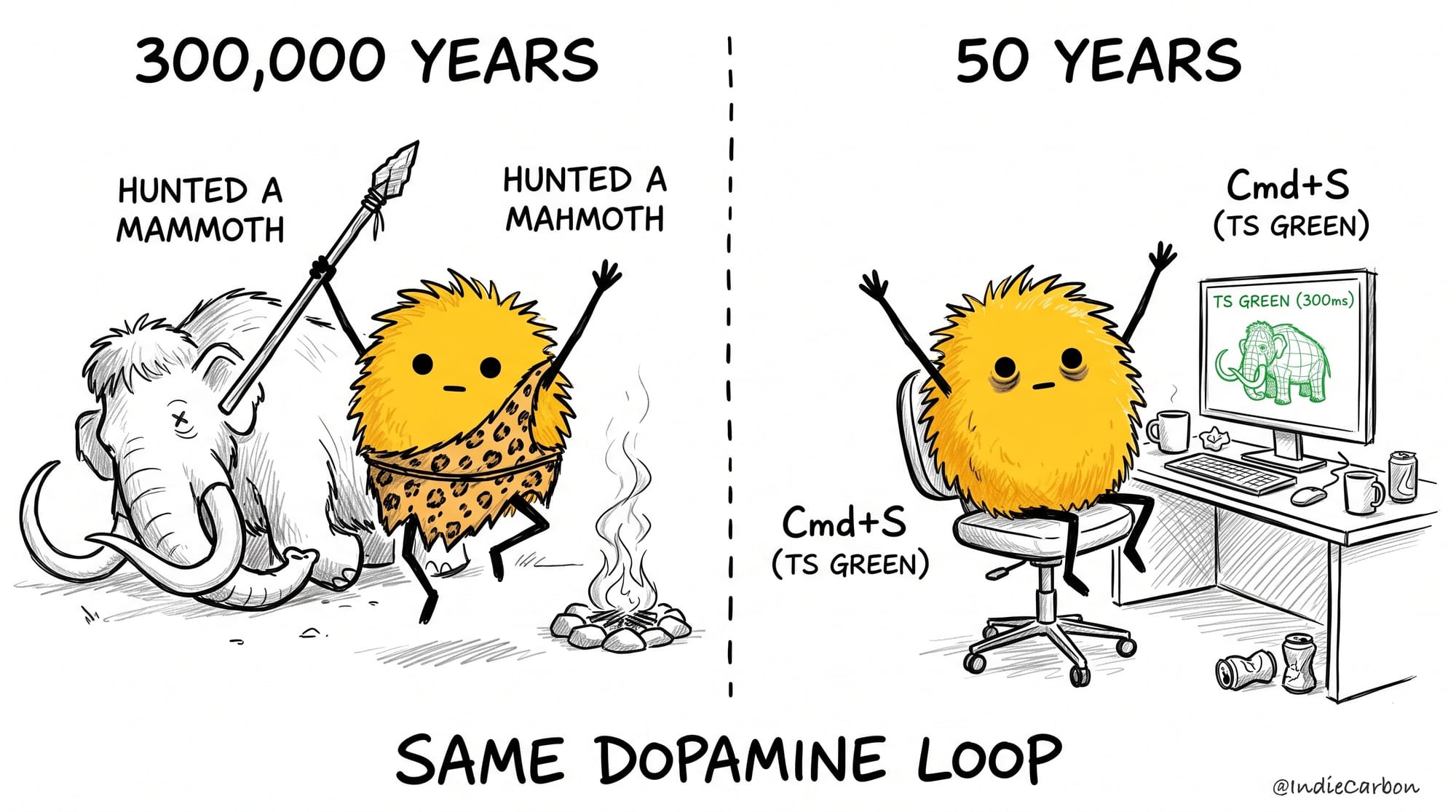
Your editor is a giant Skinner box. Hit Cmd+S, TypeScript flashes green in 300ms, and red squiggles vanish. Instant, frictionless dopamine.
You hammer keys for six hours without water, like a rat on a lever. Software is 50 years old; your wetware is 300,000. When the build passes green, your caveman brain honestly believes you just speared a mammoth and fed the tribe.
Safe. Productive. Totally in control.
And why does hitting Deploy terrify us?
Hitting Deploy is stepping up to an empty open mic. You put yourself out there, and the room gives you pure dead air. Not even a troll or a heckle. You are simply invisible.
Being ignored does more than bruise your ego—it registers as physical injury. Brain scans show cold silence fires the exact neural circuit that screams when you touch a red-hot stove or break a bone.
To your ancient brain, dead silence means your tribe packed up at midnight and left you in a cave to starve.
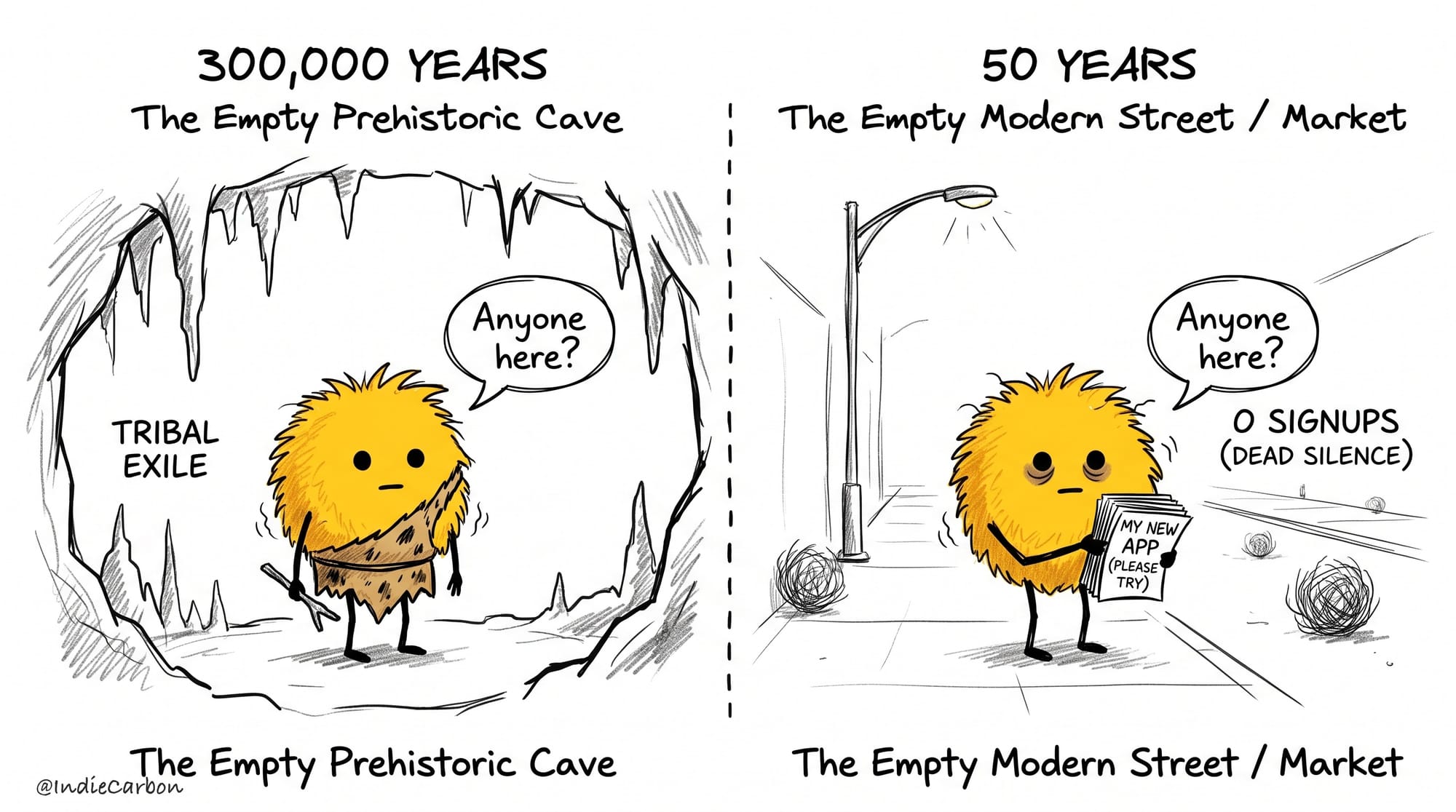
So we run back to the code. Dead silence is unbearable, so we invent an ego-saving fiction: the whole internet is watching through a magnifying glass, waiting to tear us apart over a misaligned button.
It protects our pride. To a prehistoric brain, harsh criticism is survivable; being treated like thin air is fatal.
As if anyone was actually looking.
Pure self-deception. There are no adults. Nobody cares.
Willpower won't beat biology. If your instinct is to hide behind the compiler, pep talks are useless. You need a hard physical constraint that forces you onto the stage.
The Yellow Pad on an Empty Stage
In the 2002 documentary Comedian, Jerry Seinfeld threw out every joke he owned. Tens of millions in the bank. Enough pull to sell out any stadium in North America on a single phone call. He walked down a flight of concrete stairs into the basement of the Comic Strip anyway.
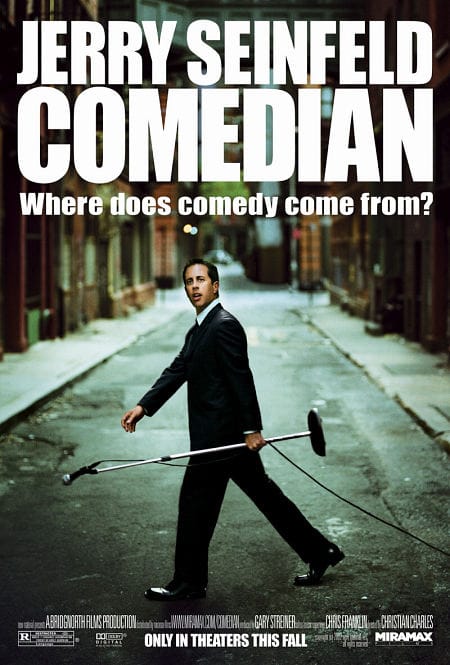
He stood at the mic with a yellow legal pad. He looked down at the page and tried a joke. The timing was off. Then he blanked on the punchline. Twelve people in the basement. Not a single laugh.
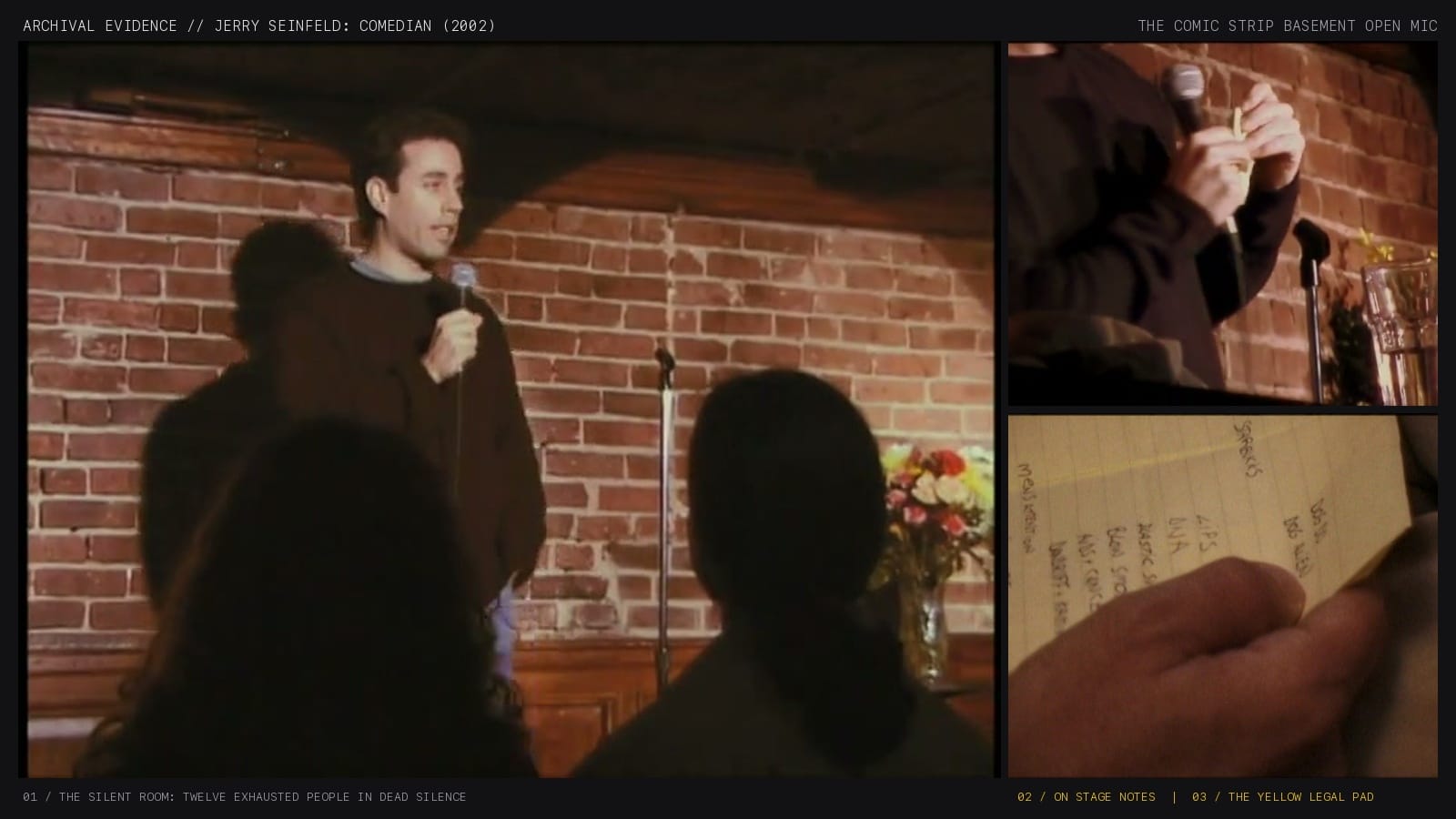
He bombed. On purpose.
Nobody writes material in a bedroom for a year and books Madison Square Garden for night one. You’d get eaten alive in three minutes.
Yet that's exactly what we do with code. We treat private repos like secret arena tours. We hoard commits in the dark for six months, then wonder why launch day is pure dead air.
At an open mic, silence gives you the truth in three minutes. If nobody laughs, the joke is dead. You cross it off the pad and try the next line.
To stop building for empty rooms, I had to run my projects like an open mic.
What earns a spot on the pad before you write a single line of code?
How do you ship completely naked, without hiding behind weeks of polish?
And who are you actually putting in the seats—polite dev friends, or paying strangers?
What to Build: The Yellow Pad Gate
Flip open Jerry Seinfeld’s yellow legal pad. No eight-page screenplay. Just two scrawled phrases: "DOG ALIEN." "STARBUCKS."
Before writing a single line of code, I force the idea through three simple questions: is anyone actually in pain, who specifically, and can I explain the fix in one sentence?
Hunt for proof of life
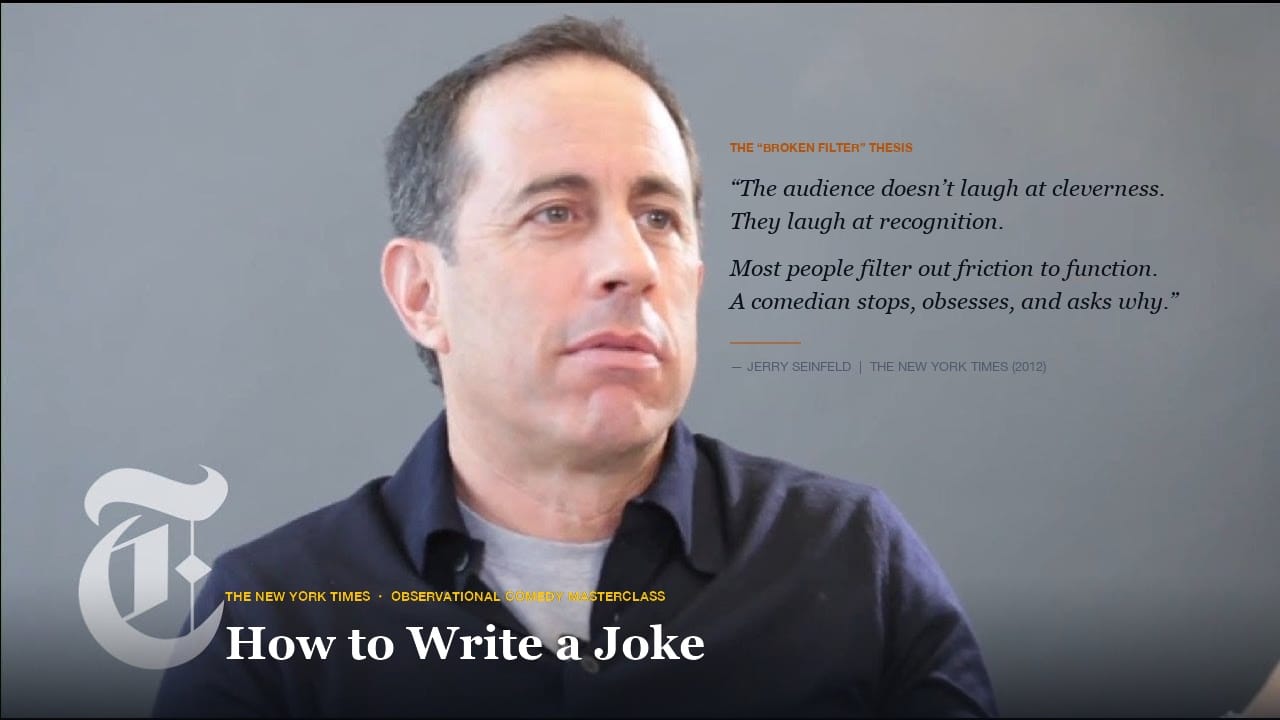
Watch almost any great observational comic walk up to the mic. Almost every routine opens with the classic premise: "Have you ever noticed...?"
They don't invent friction out of thin air.
They hold up an awkward moment everyone already lived through.
Think of Jerry Seinfeld on the flight attendant safety lecture. The crew stands in the aisle, holds up two straps with a straight face, and demonstrates how to operate a seatbelt: "Insert the flat metal end into the buckle until it clicks. To release, lift the flap."
Seinfeld didn't make that up in a studio. He sat in seat 12B, watched a crew member demonstrate a buckle to grown adults, and said what everyone in the cabin was already thinking.
We run in the opposite direction. We sit in the shower and think: "Wouldn't it be cool if there was an app that...?"
That is how you end up with a twelve-thousand-line bookmark tool that only Russian scrapers visit.
If you can't point to real people actively complaining about a headache right now, you're just building for an empty room.
Before opening an editor, hunt for proof of life in the wild:
- Public complaints: Reddit, X, or Discord posts where people vent about clumsy software or share messy scripts to get around a chore.
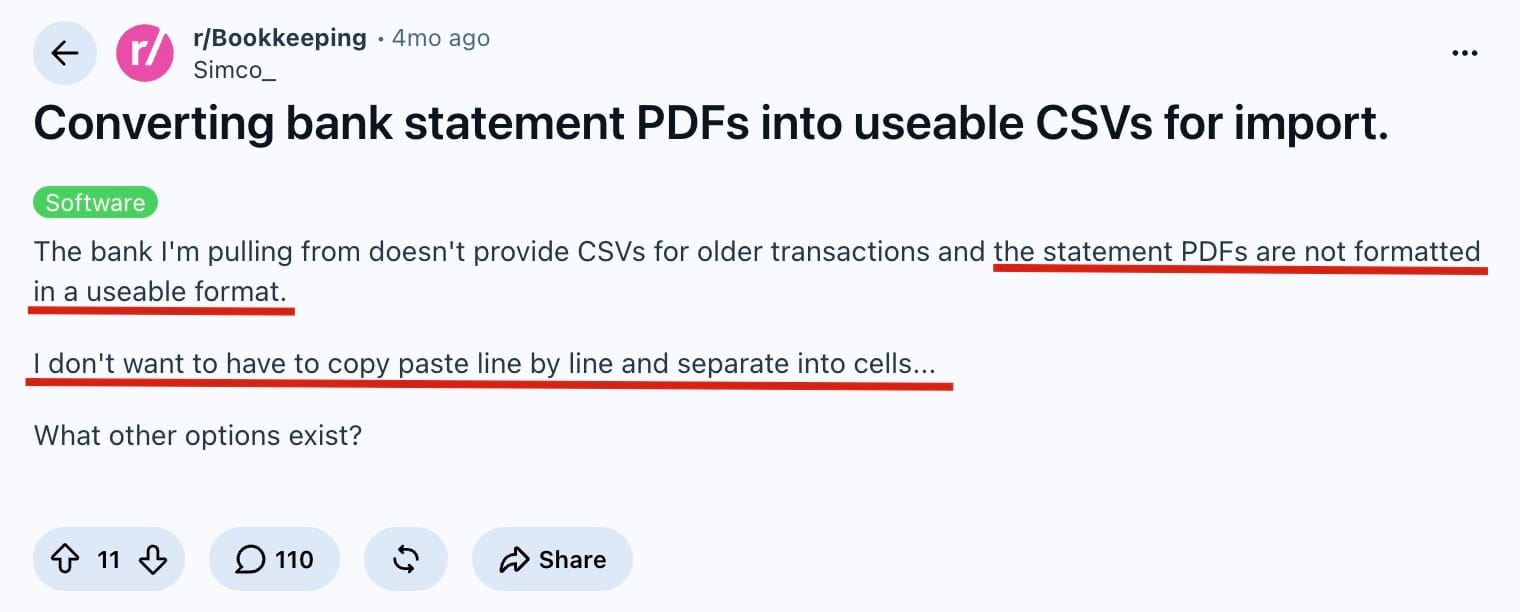
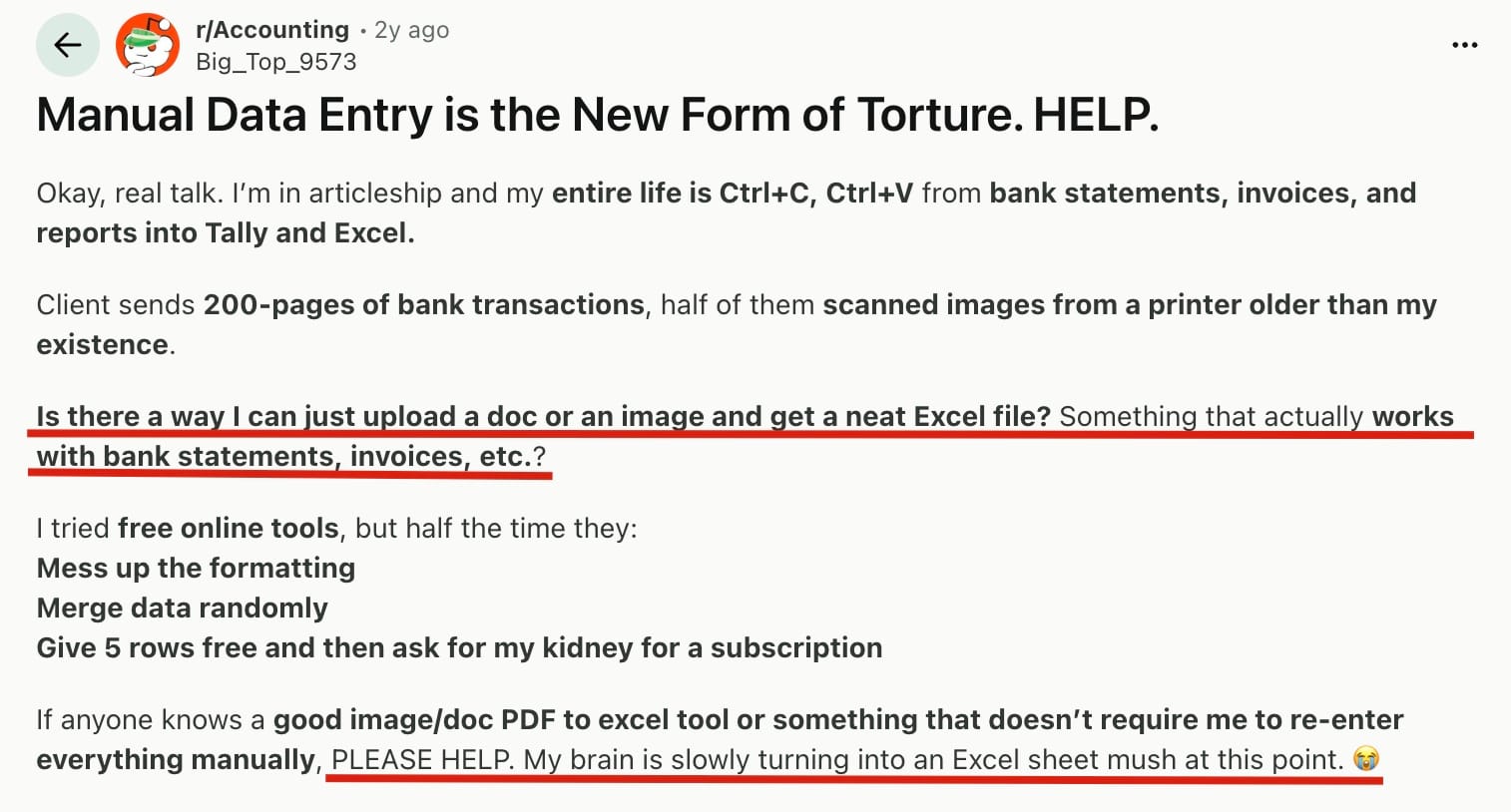
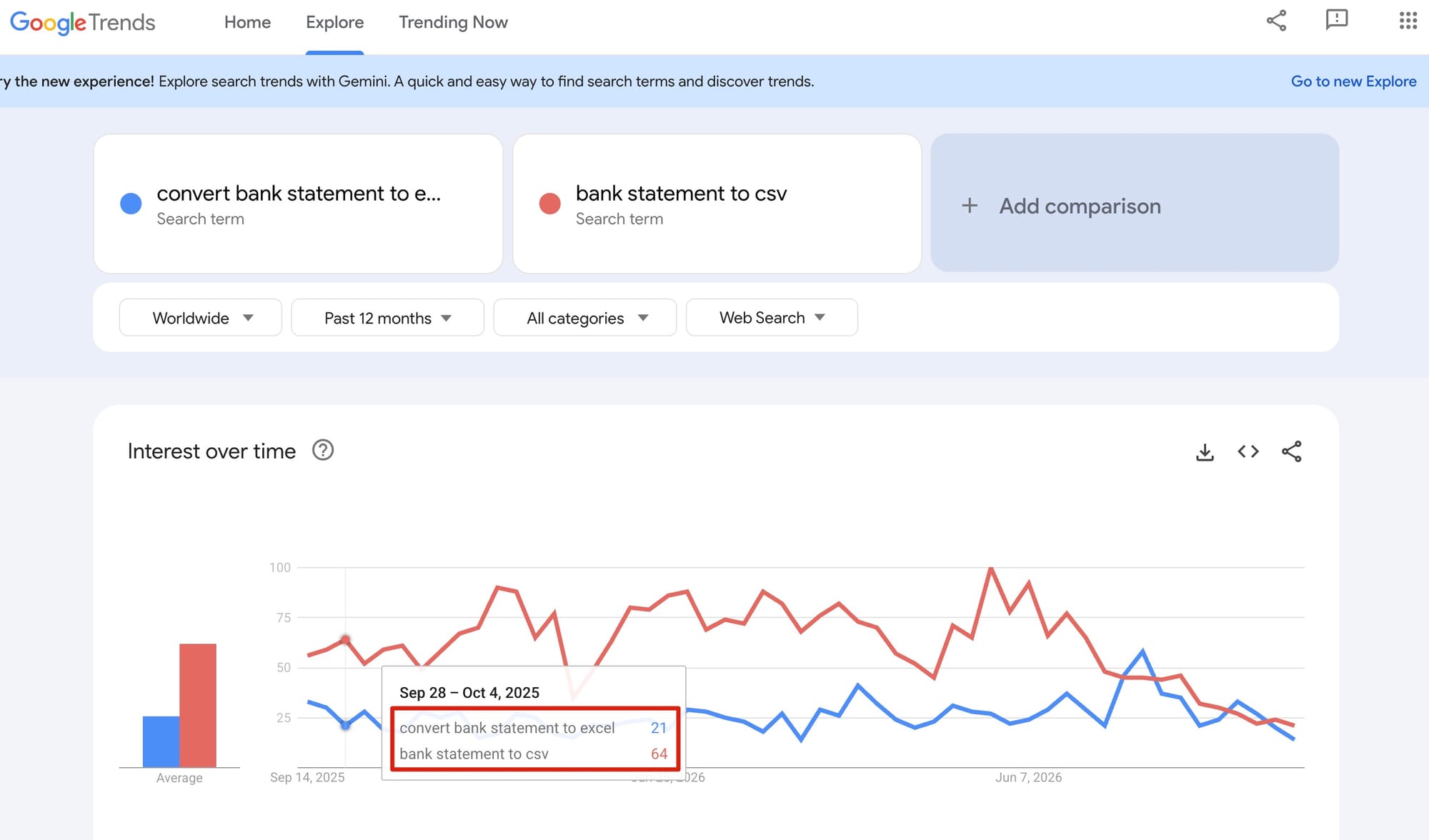
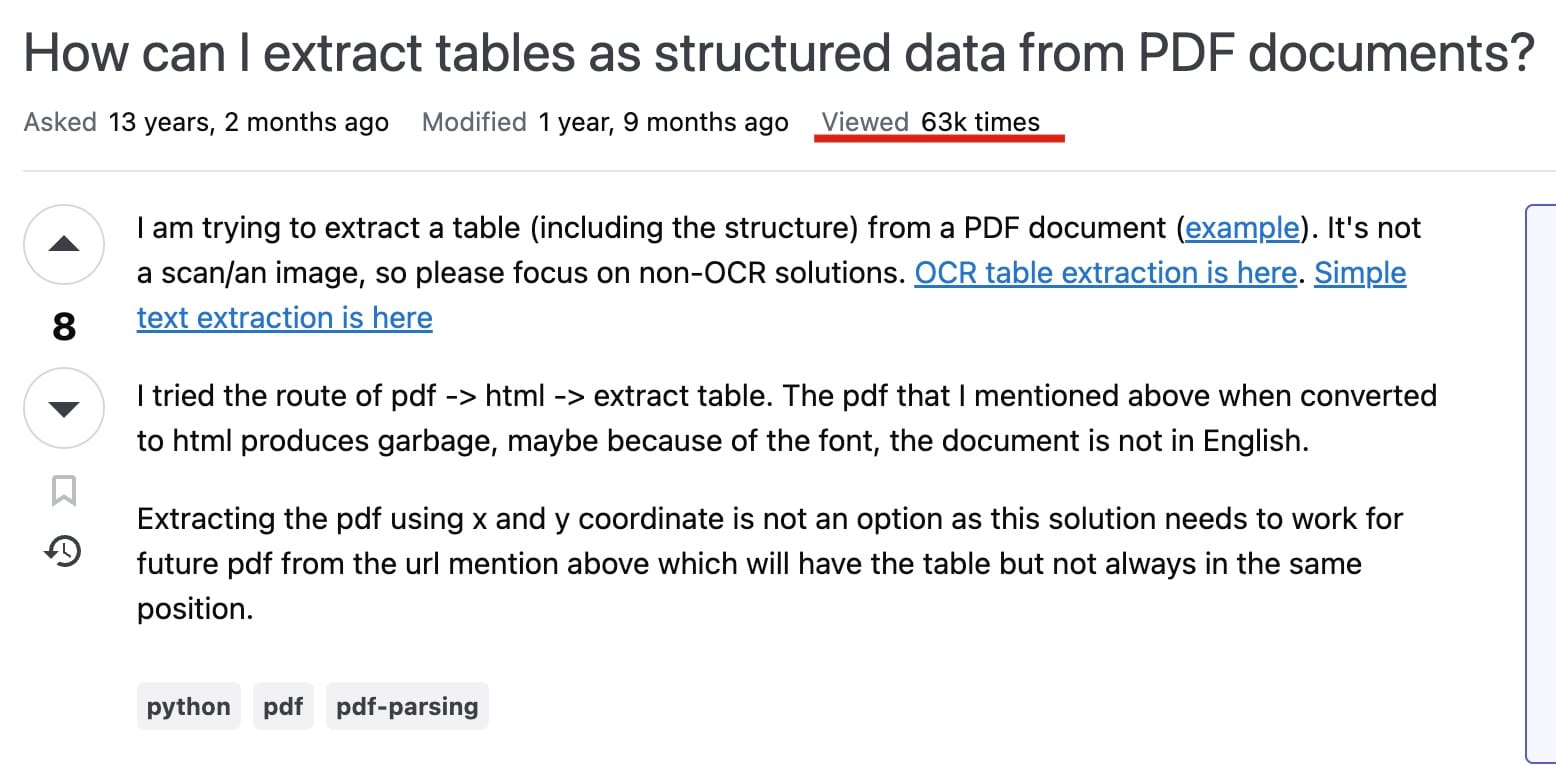
- Search volume: Google searches for simple utility tools, or Stack Overflow questions where people repeatedly ask for an easier way.
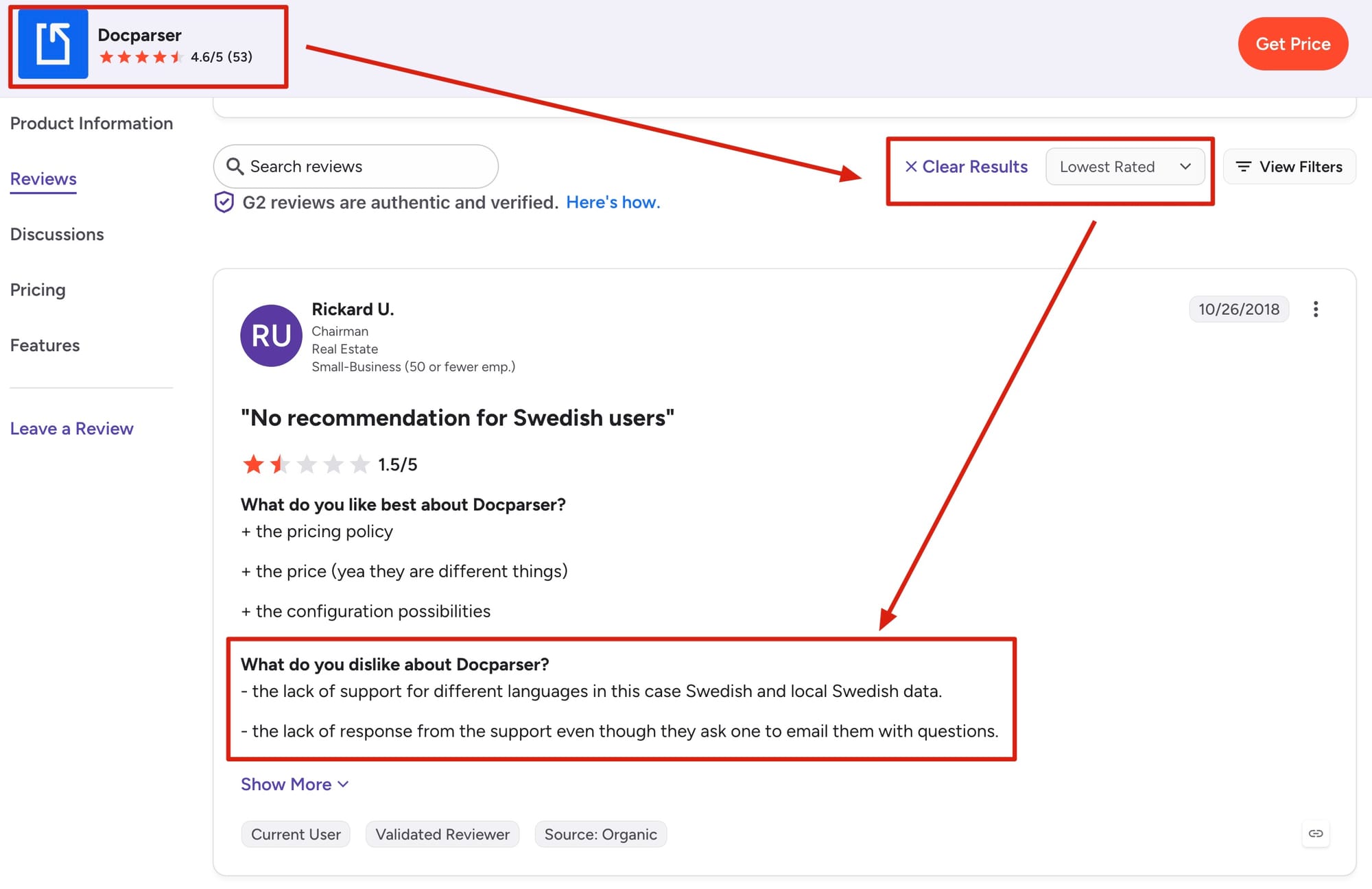
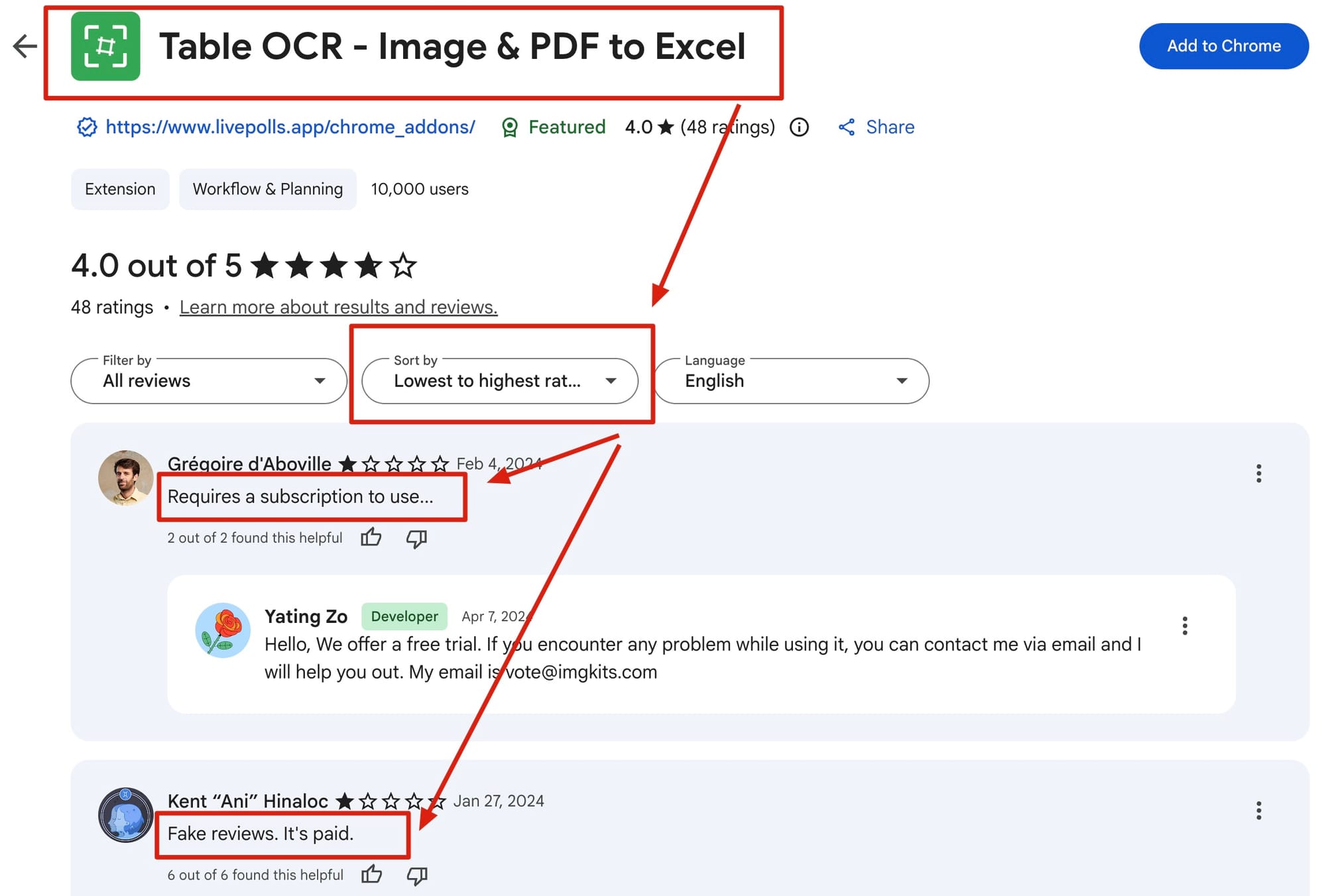
- 2- and 3-star reviews: Feedback on G2 or the Chrome Web Store where users explain what broke, what annoyed them, or why a tool wasn't worth the price.
Dig in whichever ditch you want. Just find an actual pulse before you spend a month building for people who don't exist.
Kill "everyone"
Louis C.K. spent his first fifteen years telling safe, polite jokes about dogs and airplanes. He tried to please every single person in the room.
His takeaway years later? "It was harmless, bland, and nobody gave a shit."
He only broke through when he stopped playing it safe and dug into the uncomfortable specifics.
As Mike Birbiglia put it: the more specific you are, the more universal it feels.
We fall into the exact same trap.
We take a weekend project and slap a generic tagline on the landing page: "the all-in-one tool for writers, students, and developers." Going wide feels safe.
Wishful thinking.
When you build for everyone, you build for nobody.
Big Tech won't touch a problem smaller than fifty million dollars. To feed their overhead, giants like Google or Adobe have to build generic tools for the broad middle—leaving thousands of unserved cracks behind.
To a tech giant, those cracks are a rounding error.
To an independent builder, that's an entire life.
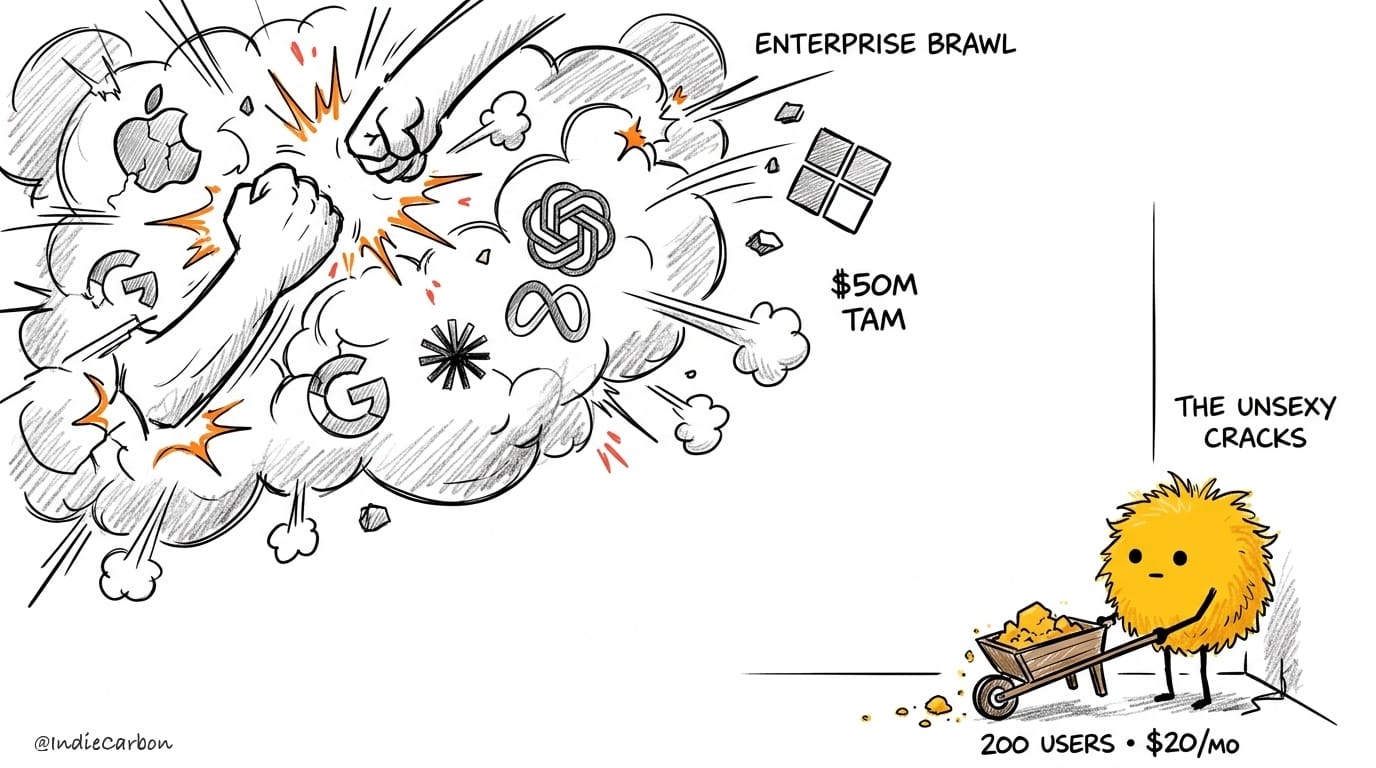
You don't need a fifty-million-dollar TAM. You only need two or three hundred people paying you twenty bucks a month to buy back your calendar.
Stop picking fistfights with corporate titans in the center of the arena. Step into the unsexy cracks they leave behind.
One atomic sentence
Comics don't draft eight-page scripts to test an idea. They scrawl a one-line premise. If it can't land in a single sentence, it dies on stage.
Software is no different. Force your entire scope onto a single sticky note: who is it for, and what specific toothache does it kill?
Builders resist this because building big feels safe. A multi-tab dashboard makes you feel like a real company.
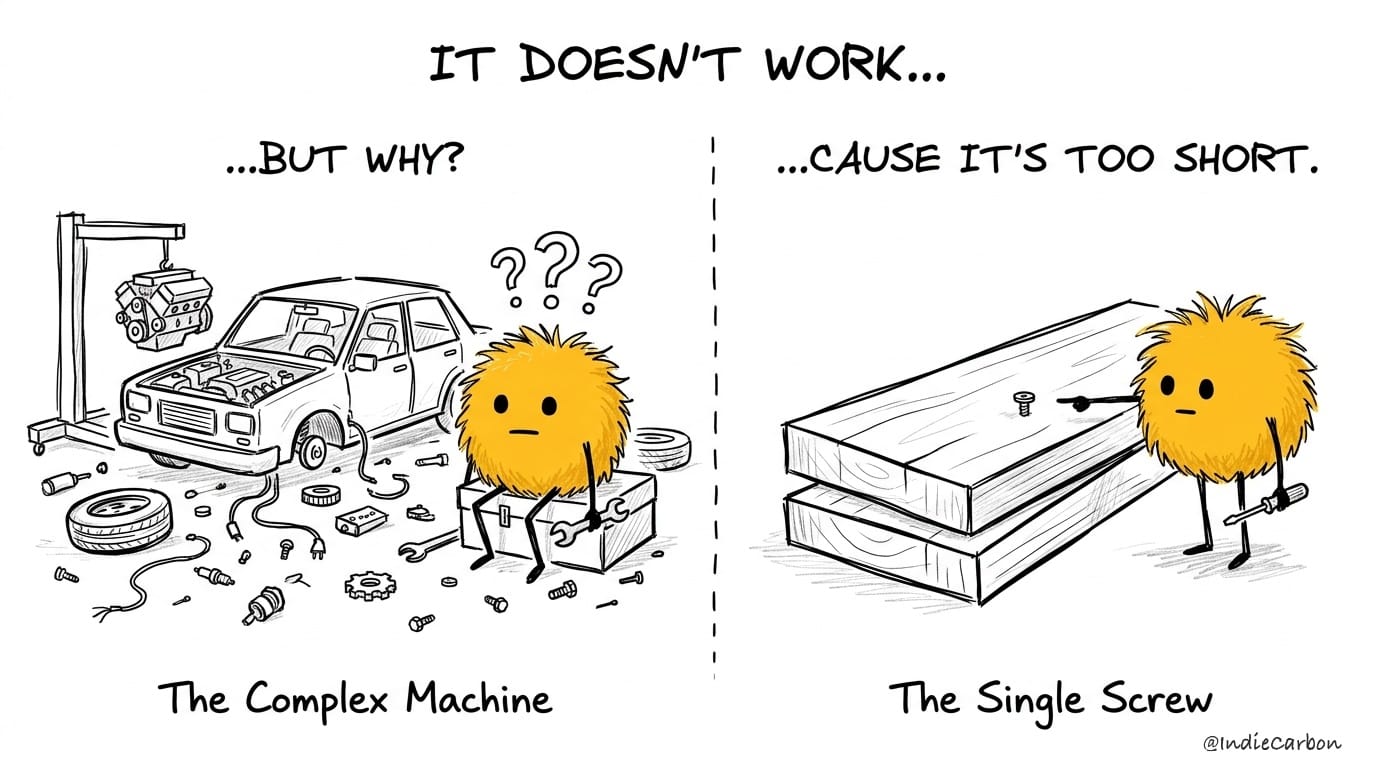
When a machine with fifty moving parts stalls, what actually failed? The transmission? The spark plug? Step three of your onboarding form?
Silence yields zero debugging signal.
A single-purpose wedge is just one screw on an empty bench. If it sits there untouched, you can't blame the transmission. The signal is instant: nobody needed it.
You don't start with the car. You start with the screw.
Complexity is not ambition. Complexity is usually just cowardice avoiding a straight answer.
"So when do I get to build more?"
I get the itch. Sitting on a single narrow feature feels unnatural when you love to build.
If you insist on expanding, keep one rule: every new feature must command enough traffic to prove whether anyone cares.
I have a neat metaphor for this.
Think of your software as a Galton board. Every user arriving at your domain is a steel ball dropped from the top funnel. Every feature you build is a collection bin at the bottom. As users tumble through your onboarding, interface, and settings, they perform a random walk across the pegboard.
The center bins catch the core need. The outer bins catch niche edge cases.
The rookie mistake is building twenty bins when you only have two balls. Eighteen of them sit bone-dry.
An empty bin gives you zero signal. You can't run an A/B test on three clicks a month. Without volume, you can never prove whether a feature actually works.
Then comes the opposite problem. Traffic finally shows up, but you're still running a single narrow slot. The center bin jams. Extra balls hit the rim and bounce right off the board.
Every ball that bounces off is a missed customer. Those are real people who showed up with a related headache, and your rigid feature just let them walk.
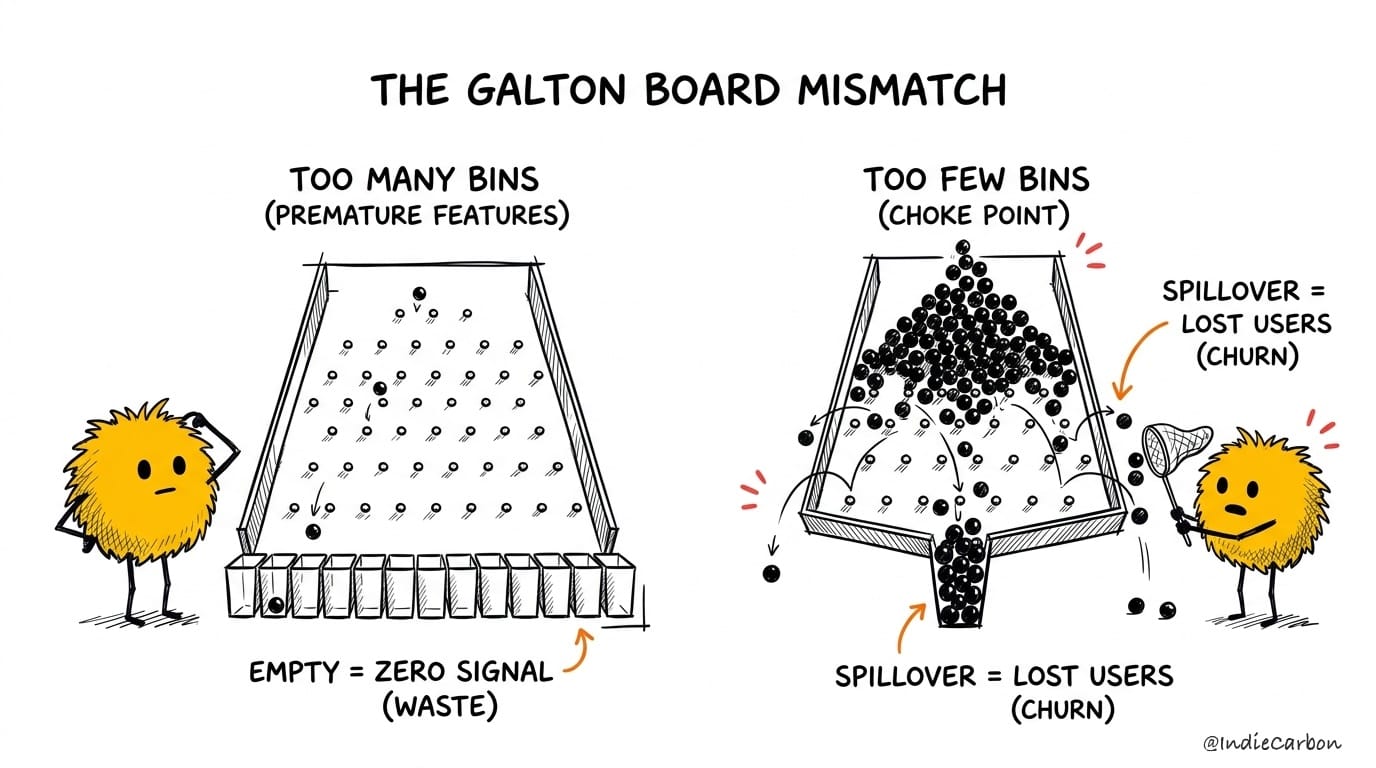
Once your first feature actually works and you want to expand, the rule is simple: never open a new bin until you have enough overflow traffic to see if anyone uses it.
Every feature has to earn its keep. If a slot won't get enough traffic to tell you whether it works or fails, you shouldn't be writing code for it.
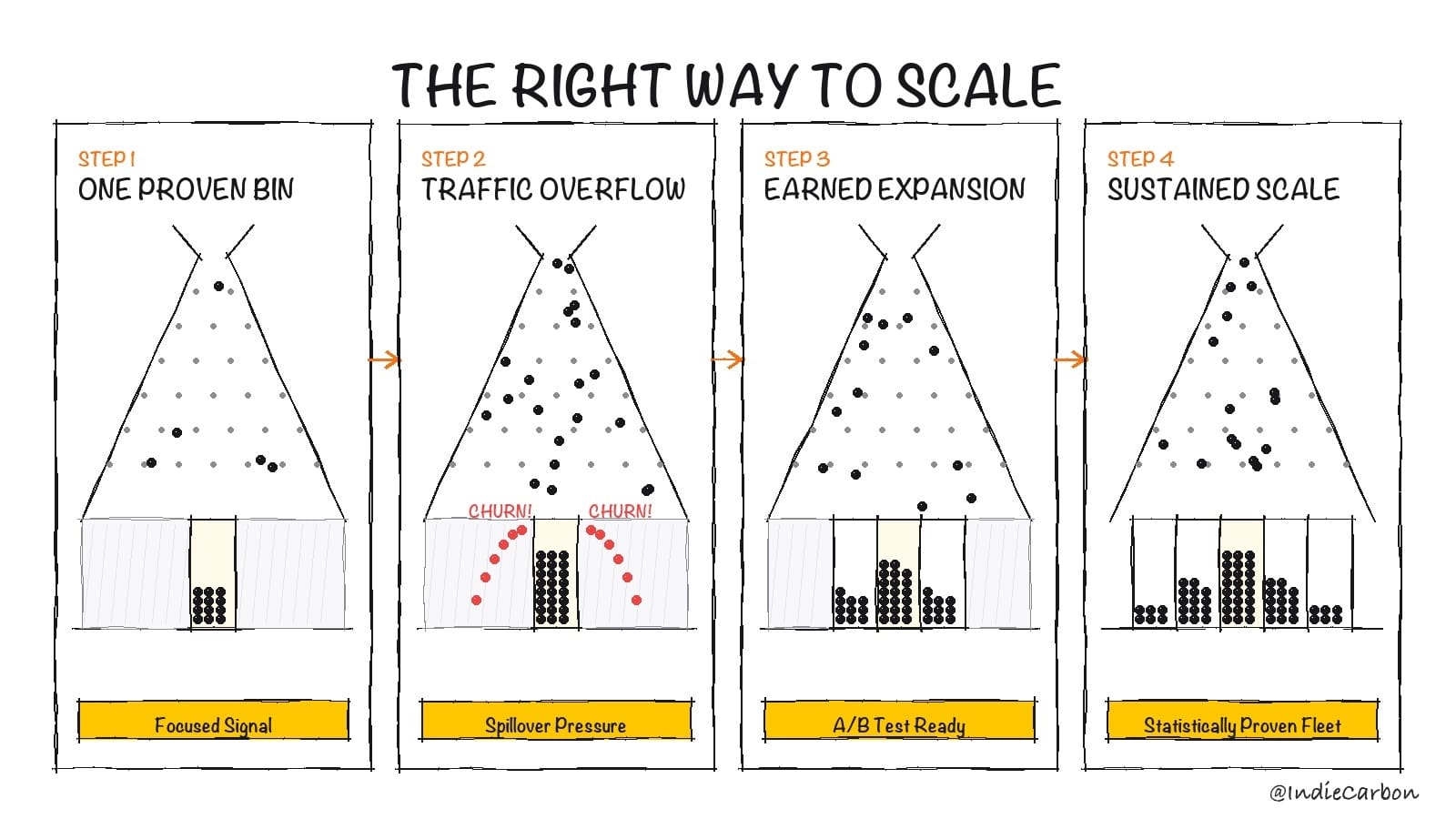
You start with one slot in the middle until it overflows. When people keep spilling over, you add the two bins next to it. That's how the board widens: every new feature handles real demand, and nothing sits there rotting.
Scale is not what you build. Scale is what your traffic forces you to support.
How to Ship: The Naked Public Deploy
Stand-up comics walk onto an open mic in whatever clothes they wore all day. No stage lights. No intro music. Just a stool and a mic.
For a builder, shipping naked comes down to two constraints: the naked mic, and the two-drink minimum.
The naked microphone
At an open mic, there is no fancy stage to hide behind. You get a mic and three minutes. If the premise falls flat, you stand there in the silence.
Software builders invert reality: we engineer arena-scale infrastructure for an empty basement.
All that polish mentioned earlier is just a security blanket. The marketing pages and slick animations exist to delay facing that silence.
Cut them all.
If an unstyled HTML button gets ignored, wrapping it in a Tailwind gradient will not save it. People did not refuse to click because the border radius was wrong. They refused because they didn't need it.
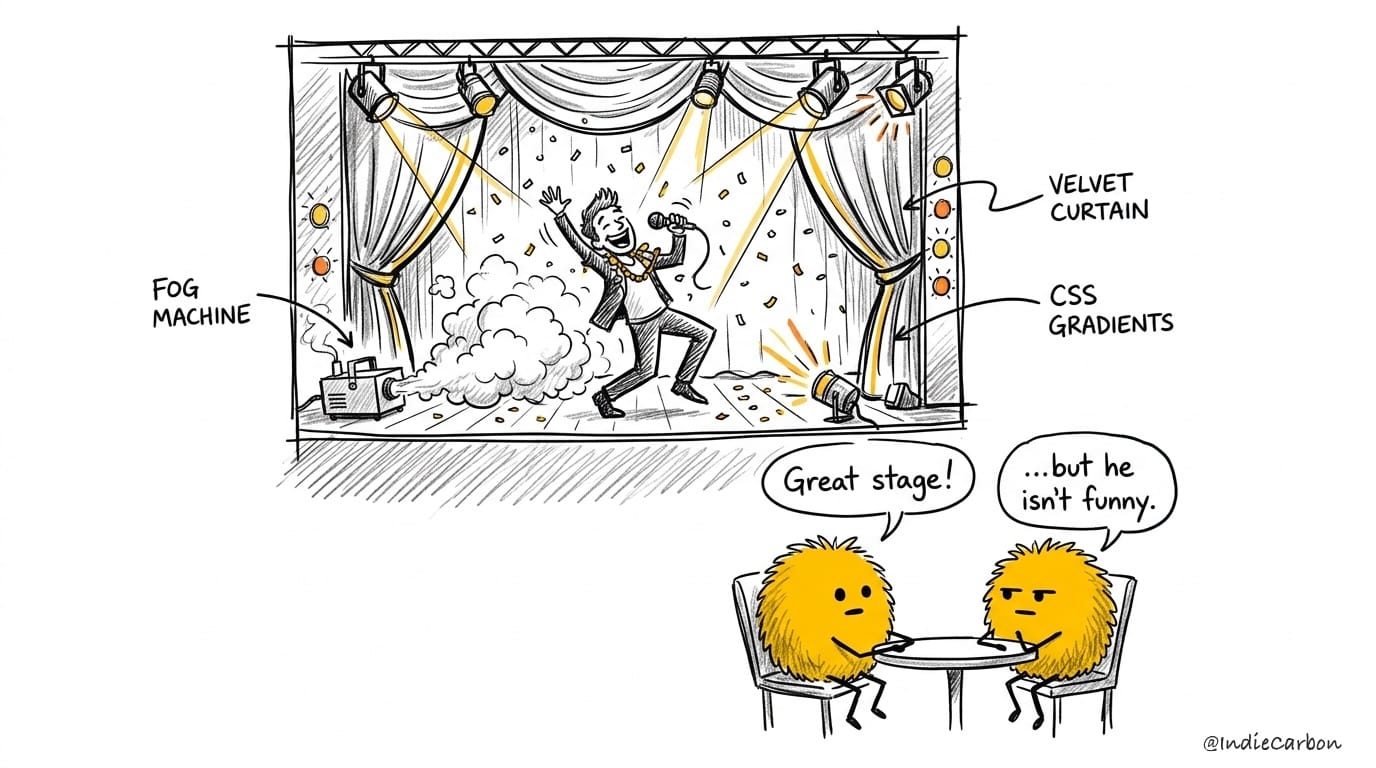
Decorations are an alibi to waste another six months polishing a joke nobody found funny.
The naked mic strips away every excuse.
Either the punchline lands, or it dies.
When a stranger pulls out a credit card for a page that looks like an internal SQLite dashboard, you know they paid for the utility. You solved an actual problem.
The two-drink minimum
Comedy clubs enforce a two-drink minimum at the door. Even with free admission, nobody sits in the dark for nothing. For software, price is the ultimate truth filter, charging from the first commit.
Free users lie.
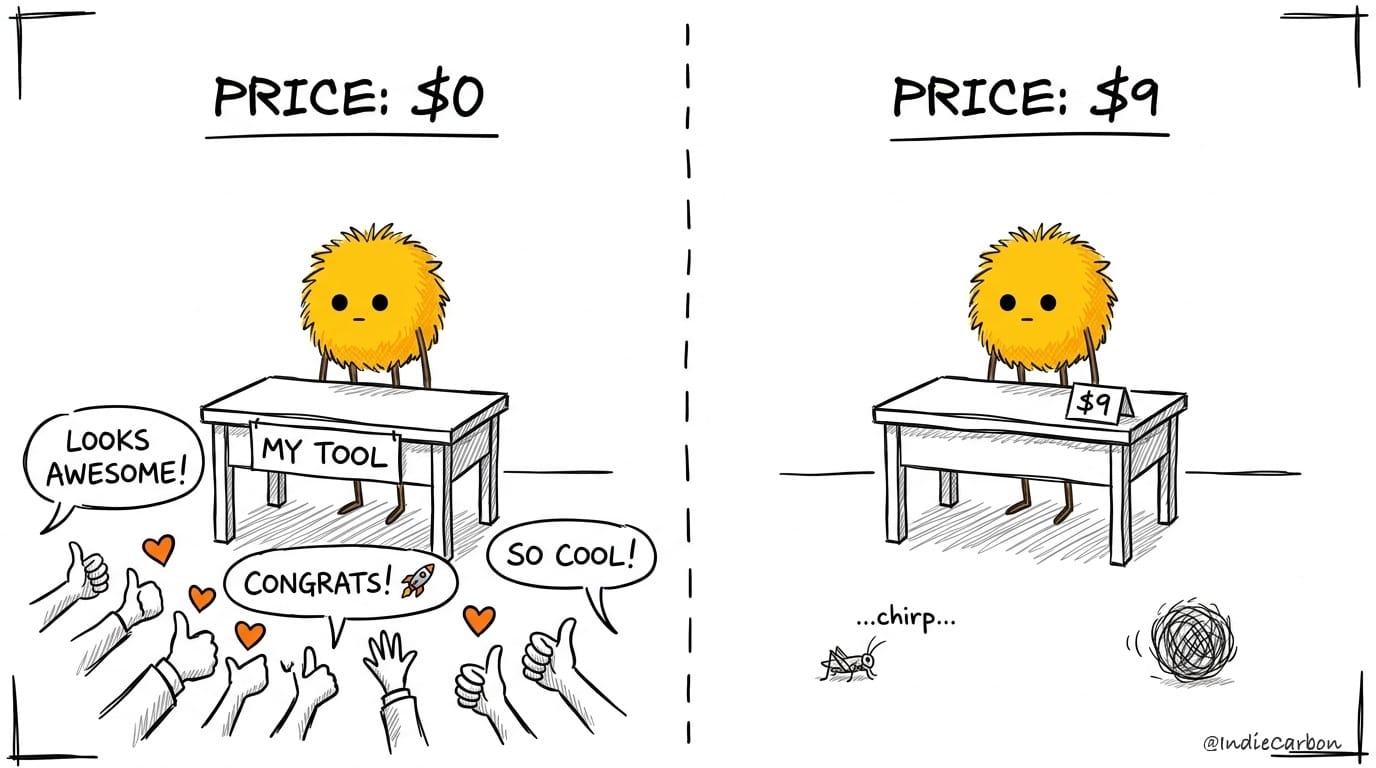
Strangers on X who reply "looks awesome, congrats!" will never give you a dollar.
Put a bare nine-dollar Stripe link right next to the output. If someone complaining about a chore refuses to pay the price of two coffees to fix it, the pain point is fiction.
A Stripe checkout is the only signal that cannot be faked.
In 2011, Sahil Lavingia launched the first version of Gumroad in a single weekend without automated payout systems. He sent payouts by hand through PayPal. Do not write automation until doing it manually is driving you crazy.
Who to Test: The Audience Ladder
A common objection builders whisper to themselves: "I would ship early, but I don't have an audience. If I drop a link today, nobody is listening anyway."
Comedians don't start with a following either. They build their audience step by step, one room at a time.
The best time to plant a tree was 20 years ago. The second best time is now.
Leave the green room
In comedy clubs, rookies love testing new material on fellow comics in the green room. It feels great—comics laugh at the inside baseball.
Jokes for other comics are a fatal trap: they only work on insiders. The moment you walk on stage in front of paying strangers, those jokes die.
Peers are peers, not paying customers.
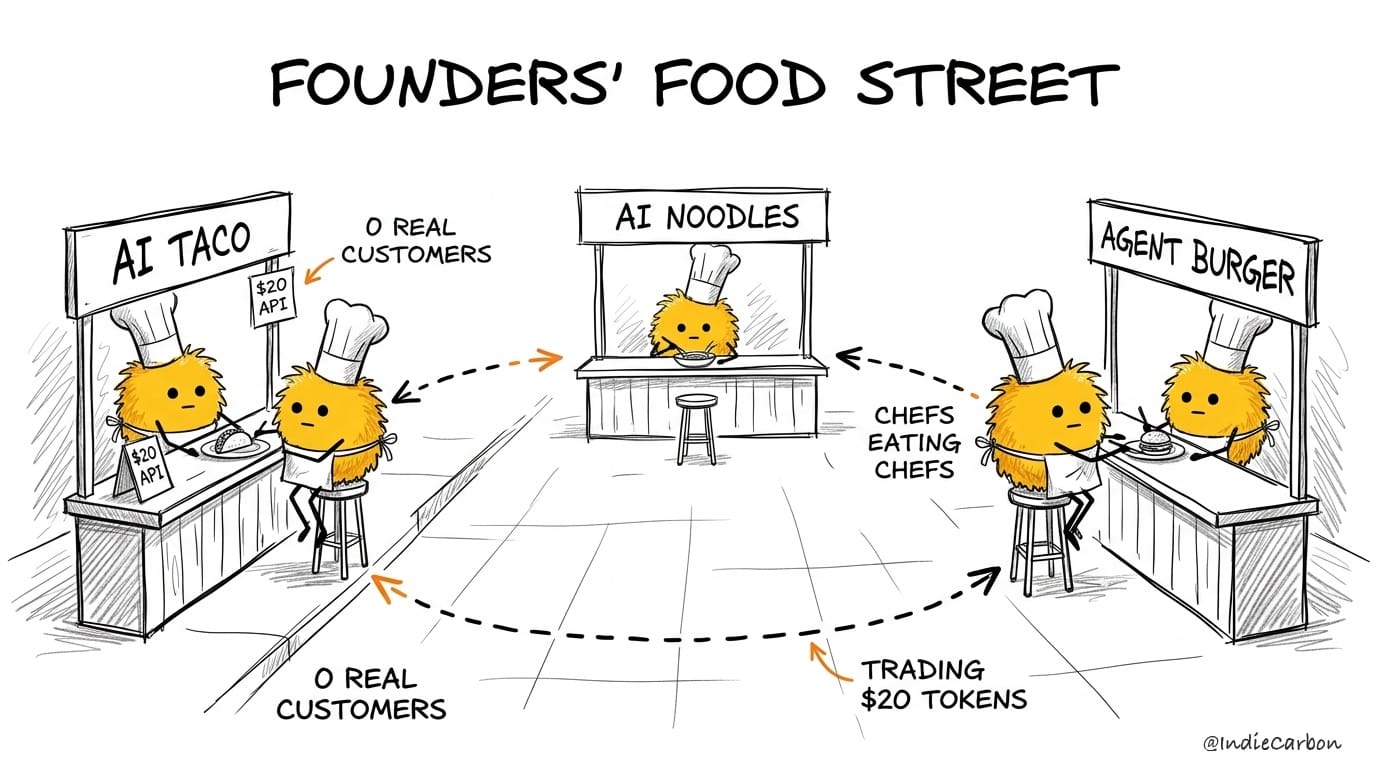
Indie developers sleepwalk into the same dead end. Look at the current AI landscape: it’s like a deserted food street lined with dozens of restaurants, where every diner is another restaurant owner eating across the street.
We build AI wrappers for other AI builders and trade praise in our private group chats. Everyone is cooking for the chefs. Nobody is feeding a hungry human being.
A chart made the rounds on X a while back.
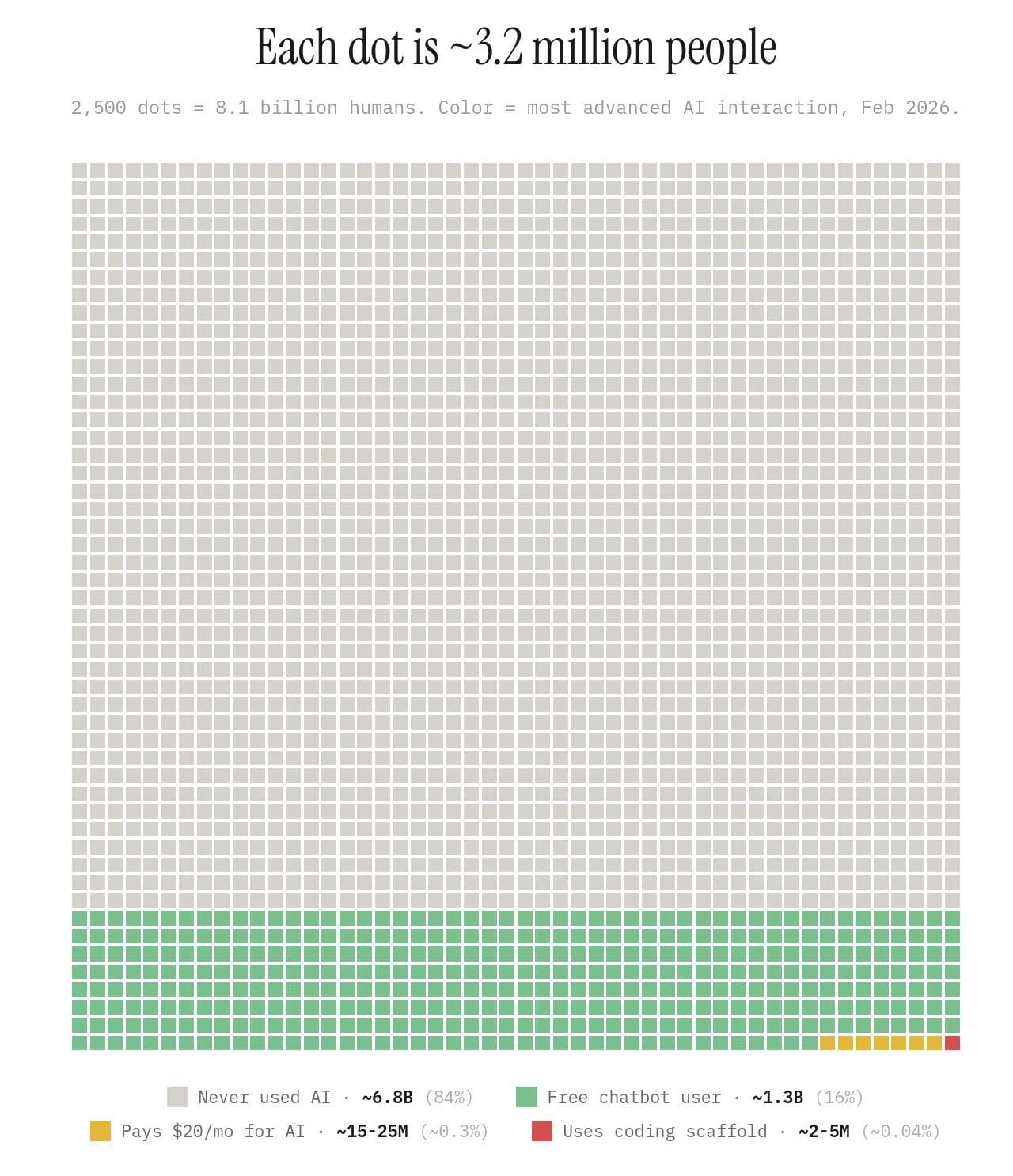
8.1 billion people on earth, and barely 0.04% touch a coding scaffold. Yet half the industry is packed into that lone red dot, selling tools to each other.
We’re shouting in a broom closet while the rest of the world just wants someone to fix their broken spreadsheets.
Step out of that 0.04% bubble and go straight to the scene of the crime. Find ten people on Reddit or X publicly venting about an ugly, manual workflow.
Once you have helped ten individuals by hand, take that solution into their niche community: the focused subreddit, the specialized Discord channel, or the dedicated forum.
Never drop an uninvited promotional link. The moment you try to extract value, people smell the transaction.
In The Minimalist Entrepreneur, Sahil Lavingia points to a golden rule: you don't sell to a community; you serve it. He highlights Nathan Barry, who hung a simple sign in his office: "Teach everything you know."
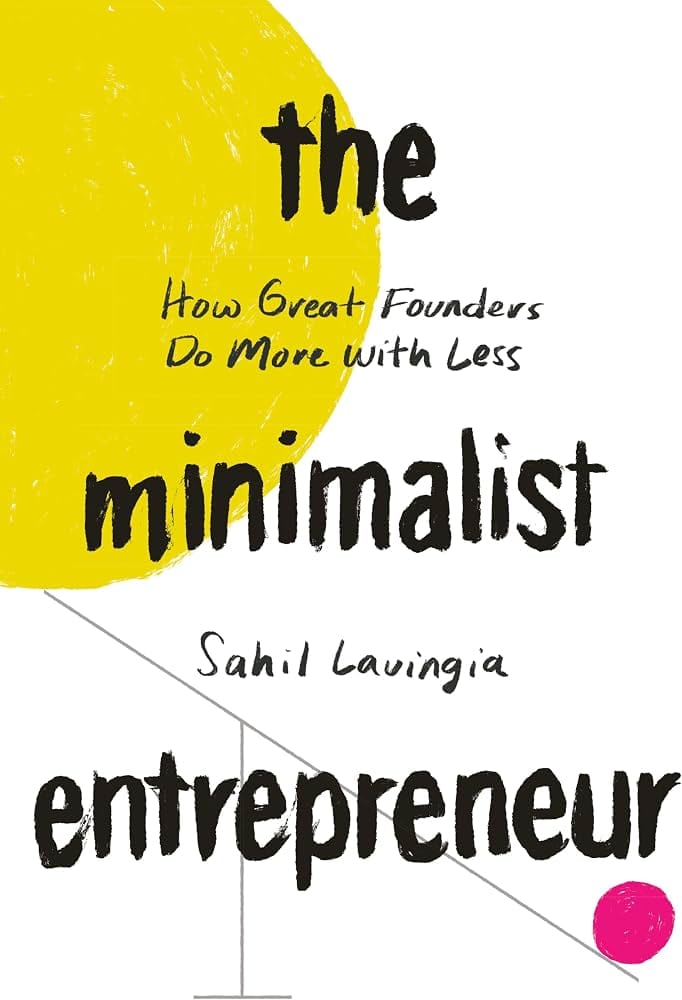
Barry didn't spam creators with sales pitches. He published brutally transparent teardowns of his design workflows, coding bugs, and pricing experiments—giving away his hardest-won lessons for free.
Never extract value from a community.
Earn the right to be heard.
Are you a draw?
In comedy, club bookers ask one question before handing you a weekend headlining slot: "Are you a draw?"
Do people buy tickets specifically to hear your voice, or did they wander in because the bar was open?
When building trust feels too slow, our default panic move is paying for a shortcut. We connect a card, dump five hundred dollars into Google Ads, and watch the traffic counter jump. Stripe doesn't make a sound. We pay for noise just to drown out the silence.
Paid ads are a high tide.
Cut the ad budget, and traffic flatlines to zero in fifteen minutes. Nobody came for your tool. You didn't build a draw; you rented a crowd.
Real distribution has no middleman. Stop hiding behind an ad manager. You cannot buy a loyal crowd; you can only meet urgent demand where people are already hurting. That brings you to raw search intent.
Nobody Googles a PDF converter at 2 AM for fun. They have corrupt data and a deadline in four hours. Hand them the wrench: take the file, spit out clean rows, and get out of the way.
Be in public, in a niche.
If thirty accountants won’t use your tool for free, ads won't save you. But when thirty people rely on your script to survive their workday, you don’t need an algorithm. You own the well.
It feels brutally slow. But building an audience step by step, one room at a time, is the most solid foundation you can ever own.
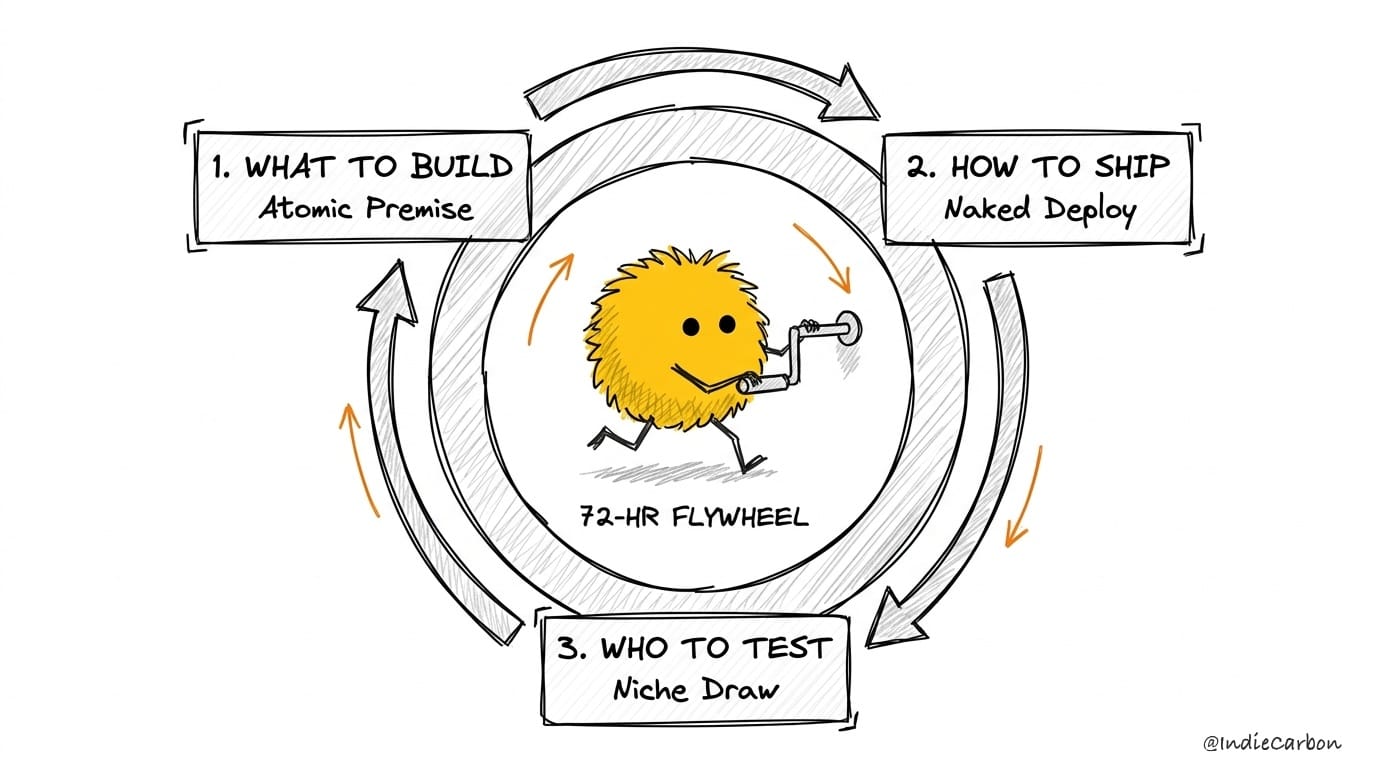
The Loop and Energy: The Feedback Flywheel
Commit on Friday. Put a bare URL in front of five people who are already complaining.
By Sunday night, you have your answer.
If it bombs, you burned three days. If someone actually uses it, you know what to build next.
The speed has nothing to do with productivity. It protects your stamina.
Grind in private for six months, and a silent launch guts you. You stare at zero signups, your chest tightens, and you can't open the editor for three weeks.
With seventy-two hours, bombing doesn't hurt.
It's just a dead git branch. You delete it on Sunday night and sleep fine.
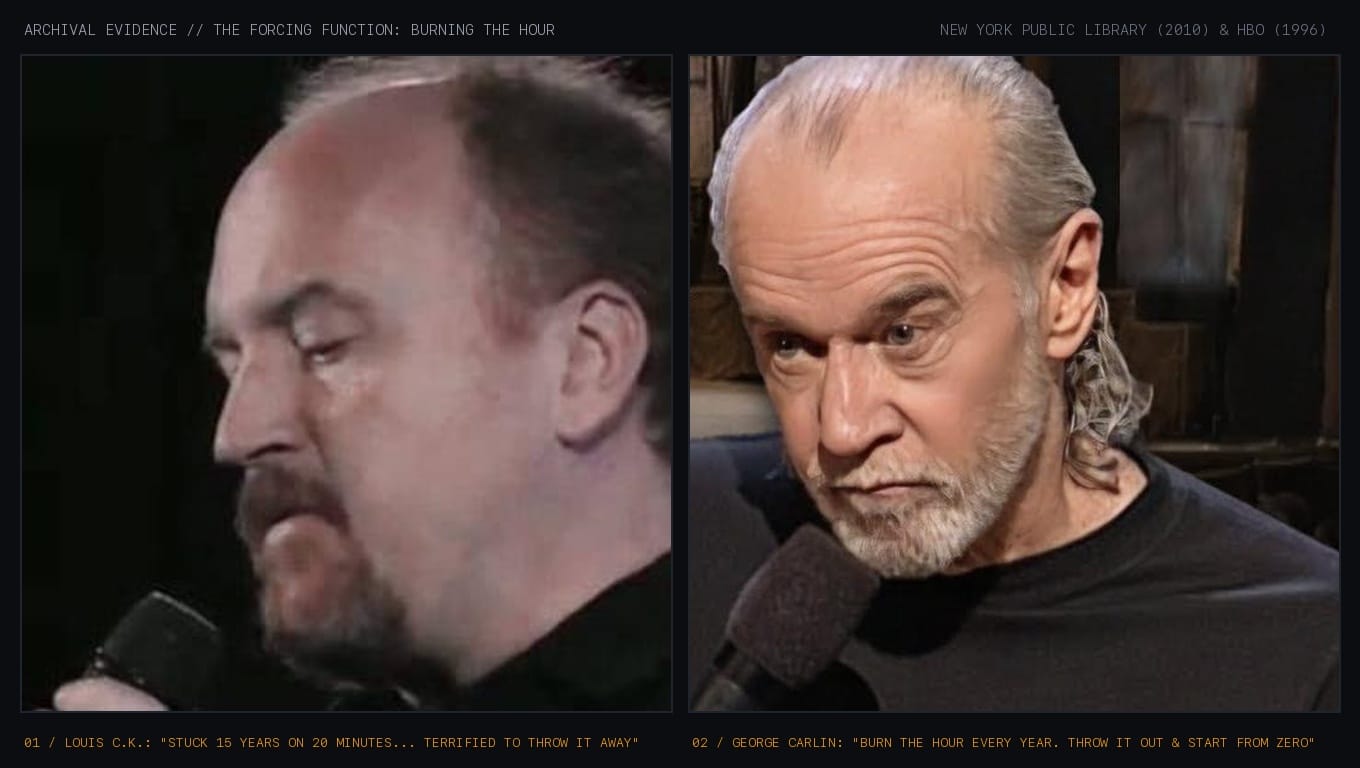
Stand-up comics have an extreme name for this: burning the hour.
Early on, Louis C.K. spent fifteen years clinging to the same twenty minutes of material. He was terrified that if he dumped those jokes, he’d have nothing left.
Then he heard George Carlin talk about his process. Every year, Carlin took his entire hour of arena-tested jokes—and threw it in the trash.
He walked right back into small basement clubs with a blank pad, sweating under bad lights, starting over from zero.
Software builders do the exact opposite. We treat private repositories like sacred museum archives.
We hoard dead features for two years, terrified to delete a function because of the hours we spent typing it.
Your code will rot. The next LLM update will wipe out that entire feature you spent three weeks building anyway.
Code is never the moat.
The moat is how fast you can throw away what failed, open a blank scratchpad, and run the next test.
Momentum survives only when bombing costs almost nothing.
The Crime Scene and the Open Mic
So here is the actual crime scene from six weeks ago.
Brutal honesty only: is this genuine tactile delight, or is it pure cowardice disguised as craftsmanship?
Roast me in the replies. If it is useless fluff, tell me to rip it out.
I build language and thinking tools at @IndieCarbon. Now drop your own crime scene in the replies—make me feel a little less alone. Whether you write code, draft essays, or ship products: What is the single dumbest detail you spent weeks obsessing over that literally zero users ever noticed?
Join the IndieCarbon Dispatch
Practical lessons on building, shipping, and automating tools in public. Free weekly dispatches.